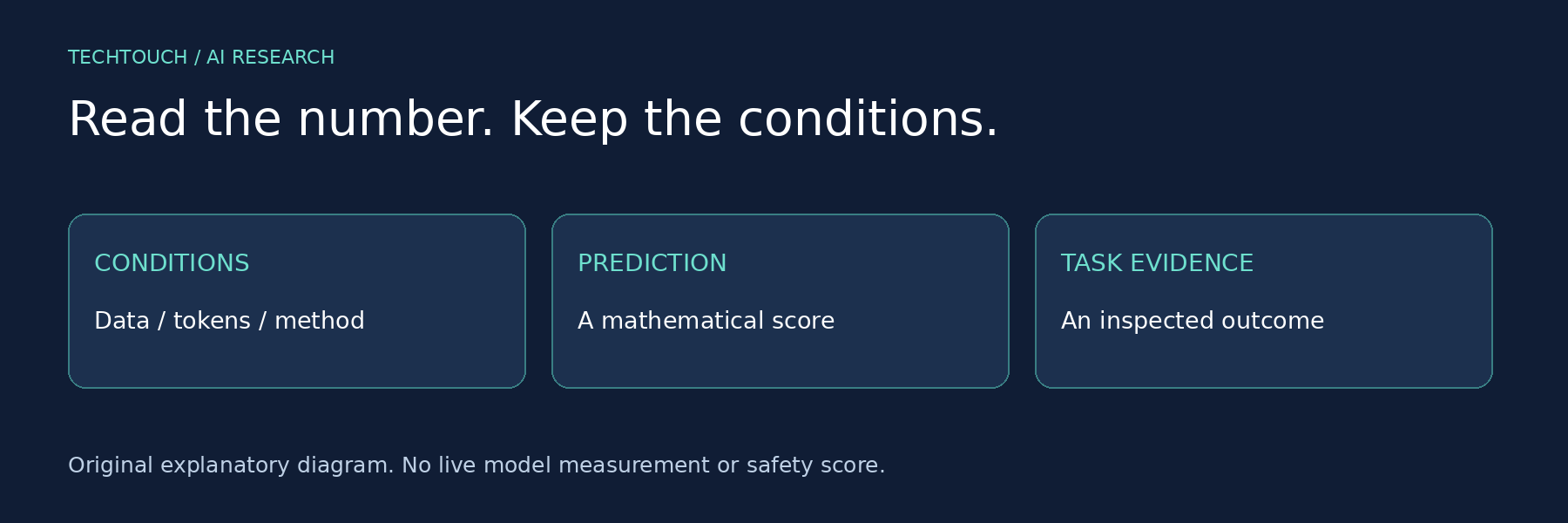
Original diagram separating measurement conditions, prediction score and task evidence
Original diagram separating measurement conditions, prediction score and task evidenceOriginal image: TechTouch ↗
AI RESEARCH · EVALUATION

OpenAI proposes perplexity for tracking AI progress. What can the number establish?

A November 22 research proposal, an original worked probability example and a practical worksheet for reading model claims.

Reading an AI measurement requires keeping its conditions visible. Our fictional worked example separates a prediction score from task evidence and shows which questions to ask before using a result.

The key points

  • Distinguish the author’s proposal from an adopted standard
  • Calculate a tiny example before reading a chart
  • Keep task acceptance results separate from prediction scores

What is being proposed, and when does it take effect?

OpenAI’s November 22 post is its chief scientist’s argument. It identifies comparison problems involving datasets, connection to tasks and advances outside pretraining. It therefore does not supply a universal league table. The proposal announces no new product availability date.
A two-token example of prediction uncertainty

TechTouch worked example: suppose a fictional model A assigns probabilities of 0.5 and 0.25 to two observed tokens. Its mean negative log-likelihood, using natural logarithms, is −(ln 0.5 + ln 0.25)/2 ≈ 1.0397. Exponentiating gives perplexity ≈ 2.828. These are invented inputs for arithmetic, not measurements of any named model.

If fictional model B assigns 0.5 to each observed token, its loss is ln 2 and its perplexity is 2. On this same tiny sequence, B assigns more probability to what occurred. The exercise has not asked whether an assistant answers a question completely, cites the right document or respects a user’s permissions.

A value of 2.828 does not mean 2.828 mistakes, an intelligence score out of ten or a percentage accuracy. A percentage decline in perplexity should not be rewritten as an equal percentage gain in intelligence without a defined relationship and evidence for it. Keep the units attached when carrying figures into a presentation.

Create a result card before comparing charts

TechTouch reading method: give each result a card identifying the evaluator, model version, data source, held-out portion and measurement unit. Add the logarithm base and tokenization procedure. A model name beside a number rounded to two decimals is insufficient for another reader to reproduce a measurement.

If one card uses Thai prose and another uses code, show them as separate observations with their conditions visible. Removing those conditions to sort a single column of numbers can create a ranking that answers different questions. When the publisher has not supplied enough information, record the comparison as unavailable instead of silently filling in assumptions.

A four-case worksheet for evaluation readers

Use the table as a fictional workshop. Start with cards A and B under identical conditions, then add card C that changes only the dataset. Ask participants which pairs still address the same question and which need separate reporting. This paper exercise requires neither personal data nor a developer account.

Next, imagine adding a document-search assistant to a workflow. Record its answers, referenced documents and authorized access. Even if task results improve, do not claim that the base model’s loss fell by the same amount. Finally, include a confident answer with incorrect evidence and ask when a human reviewer should intervene. None of these cases has been run against a live service.

Questions to carry into the next report

TechTouch analysis: transparency becomes useful when readers can inspect the measurement method and the boundary of its conclusion. Ask what can be independently checked, how the measurement connects to the work under discussion, and which harmful outcomes the evaluation has not examined. For a working team, retain its own acceptance criteria and failure examples alongside research reporting. A single research metric should not stand in for a review of an entire system.

Details and limitations

Fictional caseRecordPermitted conclusion
Change only the modelSame data, target tokens and tokenizationCompare within those controlled conditions
Change the datasetThe text type and difficulty that changedTreat it as a different experiment
Add a search toolSame task, answer evidence and referencesEvaluate the tool-using system separately
Test consequential workAcceptance rule, reviewer and failure casesConclude only within the tested scope

Things to know and check

  • Identify the proposer and publication date
  • Distinguish loss, perplexity and task accuracy
  • Compare only when conditions support it
  • Retain task results and limitations separately

Sources used for verification

Vendor facts are separated from TechTouch guidance. Features, pricing, and commercial terms may change, so check dates and conditions at the original source.

  1. Jakub Pachocki / OpenAI · Perplexity and Intelligence · 22 Nov 2026
Our editorial approach

Frequently asked questions

Does perplexity here mean the AI search company?

Here it is a mathematical metric. This report does not announce a change at the company Perplexity.

Is the worked example a benchmark?

No. It uses fictional probabilities and hand-checkable arithmetic. No model was called and no provider was scored.

Has a new mandatory standard taken effect?

The cited post is the author’s proposal. Do not turn that status into a requirement or agreement without evidence.

Custom GPT migration and export verification