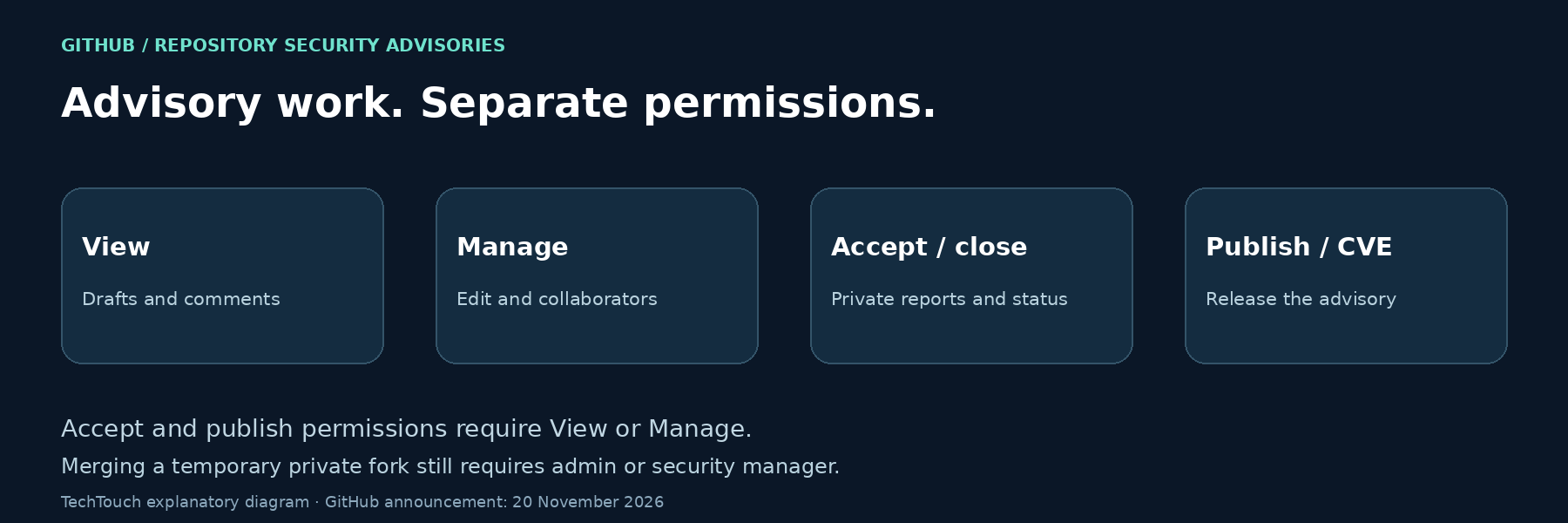
Four advisory permissions split viewing, managing, accepting reports and publishing; private-fork merging retains privileged requirements
Four advisory permissions split viewing, managing, accepting reports and publishing; private-fork merging retains privileged requirementsOriginal image: TechTouch ↗
Security · Developer tools

GitHub separates repository advisory duties: viewing, managing and publishing need different permissions

GitHub’s November 20 advisory-permission release explained through plan scope, private-fork limits and a fictional four-role acceptance exercise.

GitHub made security advisory permissions for custom repository roles generally available on November 20, 2026. Organizations on supporting plans, including Enterprise Cloud, can delegate repository-scoped advisory work instead of granting broad administrator access. Merge and confidential-comment restrictions still need separate attention.

The key points

  • Scope the assignment to a repository and inspect other inherited access
  • Distinguish accepting a private report from publishing an advisory
  • New advisory permissions do not cover every temporary-fork operation

What the new permission groups separate

The announcement introduces viewing, management, intake/closure and publication/CVE capabilities. The last two require a viewing or management grant. An organization can assign the custom role to people or teams on the repositories they need to handle.

TechTouch analysis: start with the work. Who reads the evidence, who talks with the reporter, and who decides that a notice is ready? A team name does not answer these questions. Smaller roles make the intended boundary easier to discuss, but a role design still needs to be checked against its actual assignments.
A named role still inherits a base

Custom-role documentation starts with a base role and adds permissions. Grants from multiple sources accumulate. Assigning a narrower custom role therefore does not automatically remove a person’s other access. Confirm the organization’s supporting plan and inspect organization, team and repository grants together.

TechTouch analysis: write negative expectations as well as successful actions. An account that already administers the repository is a poor way to demonstrate a limited role: a successful action may be using another grant. Have the reviewer identify the source of access rather than treating a familiar role label as an effective-permission report.

Intake is different from public disclosure

The private-report guide explains that accepting a report opens a draft advisory without making it public. The advisory-permission reference distinguishes an advisory collaborator from someone who can write to the repository. Confidential comments depend on repository write access; the new announcement additionally specifies the management grant.

TechTouch analysis: keep the status record explicit: received, investigating, fixing, awaiting editorial review and published. Receiving a report is not evidence that the vulnerability is resolved. Ask for a separate remediation result and a named reviewer before communicating that a fix is complete. That also gives the next coordinator a clear point from which to continue.

The temporary private fork has its own boundaries

GitHub’s release keeps merging from a temporary private fork with repository administrators or security managers. None of the new advisory grants permits deleting that fork. The fork tutorial also explains that integrations, including CI, cannot access this area and that ordinary status checks do not run there.

TechTouch analysis: define how a patch will be checked inside an authorized environment, who reads the results and who merges it. An absence of failed checks is not a passing test run. Do not move confidential vulnerability material into an external destination simply to obtain a more convenient test service. Record unavailable checks and their consequences for the release decision.

A fictional four-role rehearsal before an incident

TechTouch example: prepare a written scenario for a repository named sample-notes. The only invented report says that an issue has been received and its impact still needs investigation. Include no exploit, customer record or real vulnerability claim. Use the four roles in the table and name one coordinator to review the proposed assignment with the administrator.

Before predicting a result, list the base grant, team memberships and added permissions for each intended account. Give every role one allowed action and one excluded action. For example, the reader should be able to inspect the assigned draft while publication belongs to a different duty. Separate a review of configuration from any exercise that would change external state. Do not submit a fake vulnerability report or request a CVE just to demonstrate a control.

Set a reviewable acceptance criterion: the administrator can trace who receives each capability, where the grant comes from and why that person needs it. Retain unanswered questions as unverified. After a team change, revisit the record and identify who removes access when the duty ends. Have both the technical maintainer and the communications owner sign off on their own responsibilities before widening the pilot. This is a proposed TechTouch exercise, not a live GitHub account test or evidence that a particular organization is configured correctly.

Details and limitations

Fictional pilot rolePlanned capabilityAcceptance question
ReaderViewCan the account see the assigned draft without publishing it?
CoordinatorManageCan it maintain the record while publication stays separately assigned?
Intake reviewerView plus AcceptDoes accepting a report create a draft rather than a public notice?
PublisherView plus PublishIs content review and a named decision owner in place?

Things to know and check

  • Check the plan and custom-role scope the organization actually has
  • Separate base grants, additional permissions and team-derived access
  • Name the content reviewer and the patch-merge decision owner
  • Record unverified restrictions separately from passing cases

Sources used for verification

Vendor facts are separated from TechTouch guidance. Features, pricing, and commercial terms may change, so check dates and conditions at the original source.

  1. GitHub Changelog · Advisory permissions GA · 20 Nov 2026
  2. GitHub Docs · Custom repository roles and inherited access
  3. GitHub Docs · Repository security advisory permissions
  4. GitHub Docs · Working in a temporary private fork
  5. GitHub Docs · Private report review and confidential comments
Our editorial approach

Frequently asked questions

Is this included in every GitHub plan?

The announcement scopes it to plans supporting custom repository roles, including Enterprise Cloud. Do not assume Free or Team has the same entitlement.

Does a management grant also permit merging the private fork?

The release keeps that merge boundary with repository administrators or security managers.

Has this article changed any real account permissions?

No. The roles and exercise are hypothetical guidance; no account change or live advisory publication was performed.

Copilot team plugin defaults