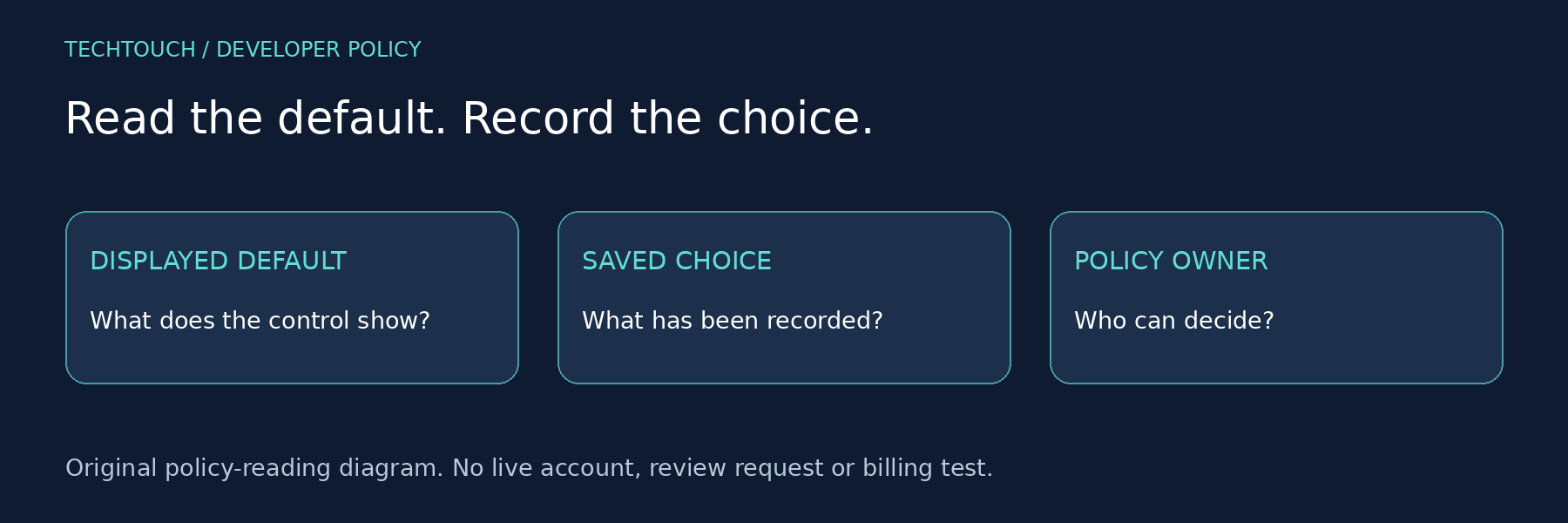
Original diagram separating displayed defaults, saved choices and policy ownership
Original diagram separating displayed defaults, saved choices and policy ownershipOriginal image: TechTouch ↗
DEVELOPER TOOLS · ORGANIZATION POLICY

Copilot code review billing changes December 30 for policies left unset

GitHub’s November 25 notice and an original exercise for distinguishing defaults from saved policy choices, without changing an account.

A displayed default can look like a saved policy choice while behaving differently during a change. This report explains GitHub’s new notice and a practical evidence review before a team decides how to handle Copilot code review.

The key points

  • Distinguish inherited defaults from saved choices
  • Identify the policy owner before deciding
  • Review evidence without generating reviews to test billing

What changes, and when?

GitHub’s November 25 notice schedules a December 30, 2026 change for Business/Enterprise policies left unset for licensed-member reviews. Eligible accounts move to Organization; saved choices remain. Accounts lacking paid AI Credits, billing-locked accounts, or those without a billable customer use Member. Unlicensed-member policy is unchanged. An enterprise owner decides enterprise-managed settings.
Separate the payer from review access

Documentation distinguishes Member entitlement from Organization billing to the repository owner. Choosing a payer grants no review access. Organization billing requires AI Credits paid usage.

TechTouch analysis: record feature permission and payer as separate fields. A reader should not assume that confirming one establishes the other. Seeing a control that requests a review does not identify the statement on which the team will find its cost. That distinction helps keep an operational checklist readable for both developers and administrators.

Four cards for a policy-reading workshop

TechTouch fictional exercise: invent organizations called Team A, B, C and D. Use the four rows above as initial states. One participant prepares cards; another reads them without an accompanying explanation and marks what has been verified versus what remains a question. Do not use customer names, account identifiers or screenshots containing personal information.

For the Default (Member) card, mark which observations come from the control and which come from the announcement. For cards with explicit choices, keep the team’s rationale beside its evidence. This workshop checks how people interpret records. It neither requests a code review nor establishes an actual GitHub billing outcome.

Hand the decision to the accountable owner

TechTouch method: each card should include organization or enterprise scope, reading date, control name, decision owner and source link. When the reviewer cannot inspect a setting, record it as unavailable rather than filling in an expected value. That gap can then be assigned to the right owner.

Before a real change, agree on the intended behavior, accountable payer and post-change evidence. Avoid creating pull requests or generating many reviews merely to discover who is charged. If authorized usage reports already exist, inspect their scope and time window first. A report from the wrong organization or period can answer a different question from the one the team intended.

What the public announcement cannot determine for you

TechTouch analysis: a product policy describes a default path; it does not establish a reader’s organization state or the cost of a particular job. Keep questions about decision authority and actual usage with the system owner. Clear configuration records can reduce misunderstanding, but they cannot prove that a review catches every defect or replaces human code review.

Details and limitations

Fictional exerciseRecord on the review cardReviewer’s question
Default (Member) displayedControl, date and policy scopeIs this a default or an explicitly saved choice?
Member displayedSelected value and policy ownerWhich evidence supports the team’s interpretation?
Organization displayedRepository owner and budget ownerWhose statement is reviewed, for which period?
Billing restriction presentObserved state and administrator explanationHas the exceptional condition been recorded?

Things to know and check

  • Distinguish defaults from saved choices
  • Record scope and the accountable policy owner
  • Separate feature access, payer and review quality
  • Use fictional workshop data instead of generating billable tests

Sources used for verification

Vendor facts are separated from TechTouch guidance. Features, pricing, and commercial terms may change, so check dates and conditions at the original source.

  1. GitHub Changelog · 25 Nov 2026
  2. GitHub Docs · Configure code review
Our editorial approach

Frequently asked questions

Was a reader’s GitHub account checked or changed?

No. This report combines official documentation with a fictional exercise. No policy was changed, review requested or live bill tested.

Does the table choose a billing policy for a team?

It is an evidence-reading framework. The responsible organization must evaluate its authorized records and requirements.

Copilot team plugin defaults