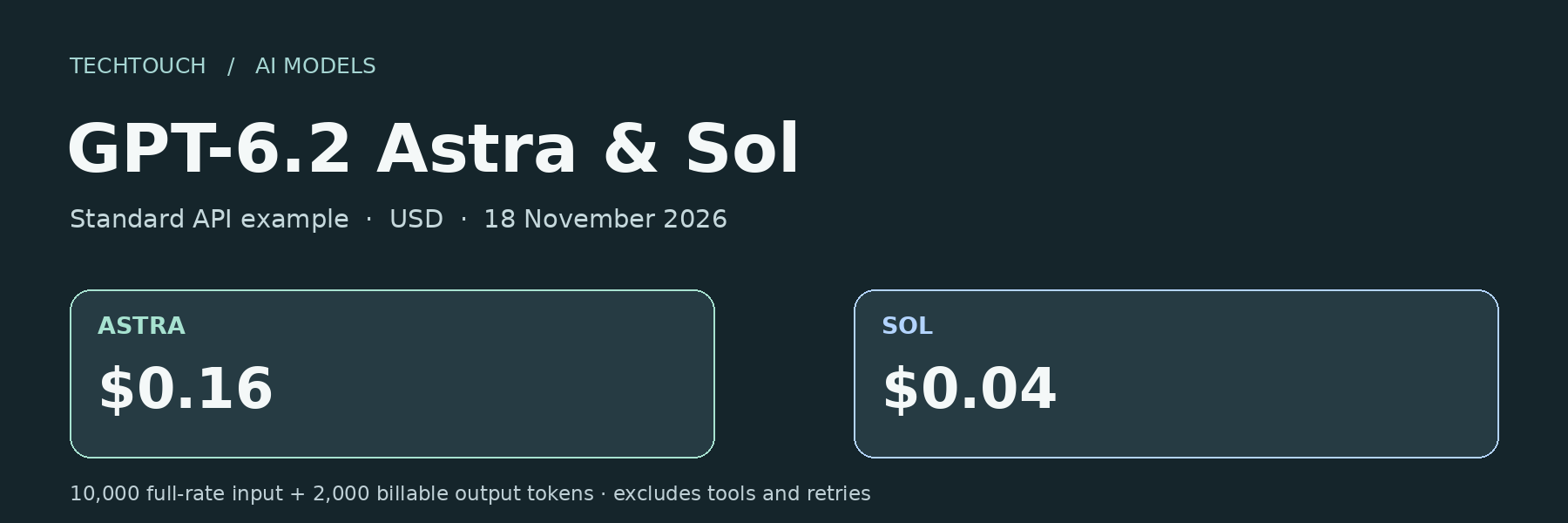
Standard API example for 10,000 input and 2,000 output tokens: Astra $0.16 and Sol $0.04
Standard API example for 10,000 input and 2,000 output tokens: Astra $0.16 and Sol $0.04Original image: TechTouch ↗
AI models · Work tools

GPT-6.2 Astra and Sol reach Work and Codex, with lower Astra API rates

OpenAI’s November 17 launch explained through access, existing workflows, Standard API pricing and a practical comparison exercise.

OpenAI introduced GPT-6.2 Astra for complex projects and GPT-6.2 Sol for everyday work on November 17, 2026. Both are rolling out in ChatGPT Work and Codex and are available through the API. Astra reduces input and output rates from GPT-6 Astra; Sol retains GPT-6.1 Sol’s rates.

The key points

  • Update the client and check the Work or Codex model picker
  • Access depends on plan, workspace policy and rollout progress
  • Compare API rates alongside output quality and revision effort

The launch focuses on multistep work

OpenAI positions Astra for demanding coding and professional projects, and Sol for everyday tasks combining text, images and tools. The company reports stronger results with fewer output tokens. Its demonstrations and benchmark results describe OpenAI’s evaluation. Teams can check how those claims translate to their own files and acceptance criteria.
Where to select a model and handle existing work

The help page describes a rollout in Work and Codex, subject to plan and administrator permissions. Update the desktop app or Codex CLI and check the picker. Existing Work conversations using Astra or Sol may offer a model switch; new conversations using Default may upgrade in place. This rollout does not add either model to the regular Chat picker.

Calculate a sample bill before comparing quality

TechTouch example: suppose one short-context Standard API run uses 10,000 full-price input tokens and 2,000 billable output tokens. Astra costs 0.01 × $8 + 0.002 × $40 = $0.16. Sol costs 0.01 × $2 + 0.002 × $10 = $0.04.

The example excludes cache writes, tools and retries. Astra’s documentation specifies higher rates above 272,000 input tokens and separate Fast and Ultrafast rates. Use measured billable usage, including reasoning counted in output, when comparing cost per accepted result.

Compare the same task from the same source files

TechTouch recommendation: give each model the same fictional monthly sales CSV and ask for an editable report. Require totals to reconcile with the source and ask it to identify missing information. Review the totals, evidence for conclusions and whether the file remains editable. Record elapsed time across the whole task, including corrections.

If a model cannot access a file or tool, record the obstacle alongside its result. A fast response still needs enough evidence and functioning tools to complete the requested work.

Details and limitations

Standard APIInput / Cached input per million tokensOutput per million tokens
gpt-6.2-astra$8 / $0.40$40
gpt-6.2-sol$2 / $0.10$10
10,000 input + 2,000 output exampleAstra $0.16Sol $0.04

Things to know and check

  • Check model access and workspace permissions after updating
  • Keep input files and acceptance criteria fixed
  • Record accepted results, total elapsed time and measured cost

Sources used for verification

Vendor facts are separated from TechTouch guidance. Features, pricing, and commercial terms may change, so check dates and conditions at the original source.

  1. OpenAI · GPT-6.2 Astra and Sol launch · 17 Nov 2026
  2. OpenAI Help · Work and Codex model availability
  3. OpenAI API · GPT-6.2 Astra model and pricing
  4. OpenAI API · GPT-6.2 Sol model and pricing
  5. OpenAI Help · Model release notes
Our editorial approach

Frequently asked questions

Does the launch retire an existing plan?

This announcement introduces models. The help page continues to describe access by plan and workspace permissions.

Does Pro 200 include every Ultrafast model?

GPT-6.2 guidance limits the Pro 200 addition to Sol Ultrafast in Codex. Pro 500 supports both models. Check the account’s model-specific access and usage rates.

ChatGPT research grant eligibility