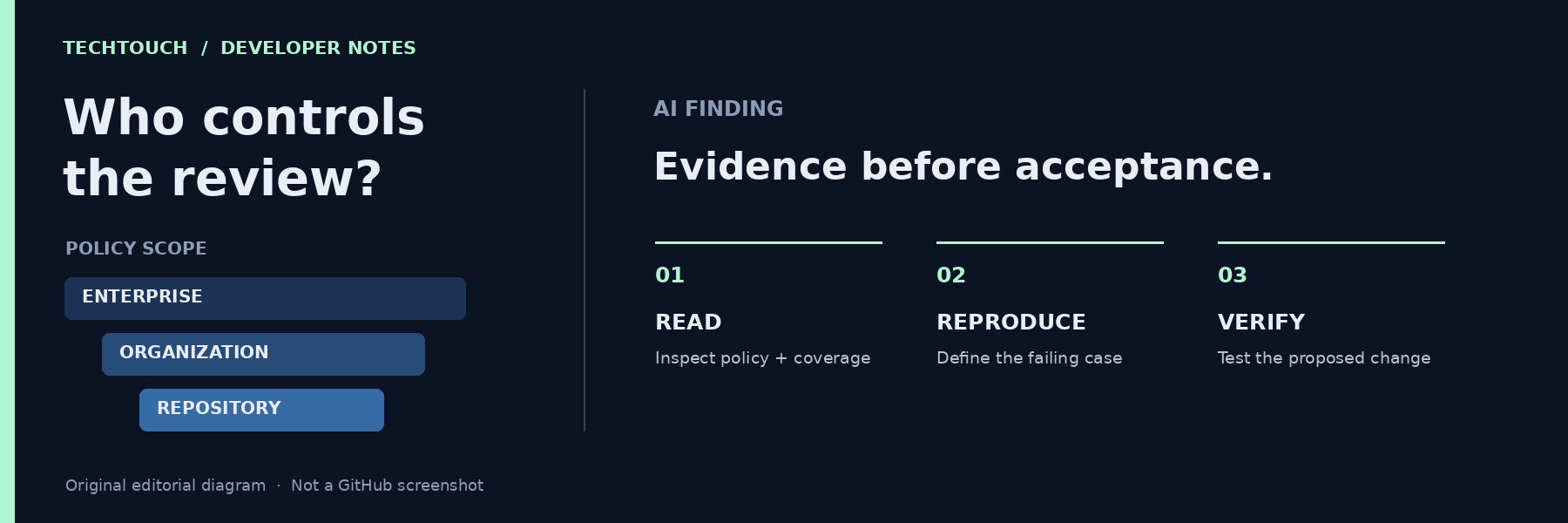
Original TechTouch diagram of policy scope and review validation; not a GitHub interface
Original TechTouch diagram of policy scope and review validation; not a GitHub interfaceOriginal image: TechTouch ↗
DEVELOPER TOOLS · AI CODE REVIEW

Copilot code review adds API controls: what administrators should verify

GitHub’s November 6, 2026 update explained: API scope, organization policies and a practical way to check AI feedback before acting on it.

GitHub announced a Copilot code review update on November 6, 2026, adding settings management through REST and GraphQL and a more compact review overview. This report examines what administrators and reviewers should check in current documentation; it does not claim a model-accuracy evaluation.

The key points

  • Separate administrative permissions from model capabilities
  • Check inherited policies and token support
  • Test AI suggestions before accepting changes

What API controls change for administrators

This is a review-control update, rather than a new-model announcement.

TechTouch analysis: machine-readable settings can help a platform team compare repositories systematically. Separate an inventory operation from a policy change, however. Applying one script everywhere without considering context can grant broader authority than the job requires. A useful inventory should explain each difference, rather than automatically erase it.

API permissions differ by scope

The announcement excludes GitHub Apps and fine-grained personal access tokens from enterprise and organization settings endpoints. Repository settings support both, with Administration: read or write for the corresponding operation.

TechTouch recommendation: starting with a recorded read. If authentication is unsupported, investigate the endpoint and role instead of immediately widening credentials. Keep tokens out of example code and logs.

Read effort settings alongside policy

Current configuration guidance distinguishes Lite, Balanced and Max, and an organization maximum that repositories cannot exceed. Balanced and Max consume more AI credits.

TechTouch analysis: record effort and task context when comparing reviews. Comment count is not a quality measure, and selecting the highest effort does not establish that every defect category was checked. Keep a repeatable acceptance standard for the code itself.

Read the coverage gaps as carefully as the findings

The revised overview groups skipped and excluded files under Files not reviewed.

TechTouch recommendation: comparing that list with important paths such as authorization code or migrations. Assign a person to any uncovered area. Silence from an AI reviewer is not evidence of safety. A cleaner presentation can improve reading speed without expanding what was inspected, so a review record should say what remains outside its scope.

A practical way to evaluate a proposed fix

Consider this TechTouch example: an AI reviewer suggests that an authorization check can be bypassed. Ask the reviewer to identify the input, user state and expected result. Build a test that demonstrates the defect, confirm that the proposed change fixes it, and check that other unauthorized paths remain blocked. Record why a suggestion was rejected as well as why one was accepted. This is a proposed workflow, not a claim that Copilot found a vulnerability in a real system.

This TechTouch exercise models an invoice read endpoint that checks read permission but omits organization ownership. Download the file below and run node copilot-review-authorization-lab.mjs. It compares expected status codes with results before and after adding the organization check, using only the fixture in the file.

TechTouch ran this fictional fixture on 11 November 2026. Before the change, a permitted reader from another organization received 200 instead of the expected 404; the other four cases matched expectations. After the change all five passed, including the permitted same-organization request and rejected unauthorized requests. This fixture uses 404 to avoid revealing whether another organization’s invoice exists.

Availability and the remaining limits

The November 6 announcement lists Pro, Pro+, Max, Business and Enterprise; it provides no separate country rollout timetable. GitHub’s responsible-use guidance warns about inaccurate or incomplete feedback and recommends supplementing human review.

TechTouch analysis: new and existing accounts should check actual entitlement and policy. An API update does not establish retirement of an existing plan. Documentation was checked November 7; no customer account API was exercised for this report.

Details and limitations

CheckEvidence to keepQuestion for the owner
ConfigurationSetting scope and inherited policyWho can change it, and who owns the decision?
CoverageReviewed and skipped filesHas someone reviewed the important paths?
Suggested fixReproduction case and test resultsDoes the change affect other behavior?

Things to know and check

  • Read settings before writing them
  • Identify the policy scope and accountable owner
  • Inspect skipped files
  • Validate suggestions with a reproduction test

Sources used for verification

Vendor facts are separated from TechTouch guidance. Features, pricing, and commercial terms may change, so check dates and conditions at the original source.

  1. GitHub Changelog — 6 November 2026
  2. GitHub Docs — configuring code review, checked 7 November 2026
  3. GitHub Docs — responsible use of agents, checked 7 November 2026
Our editorial approach

Frequently asked questions

Does higher effort guarantee complete coverage?

No. GitHub documents limitations in AI feedback; context review and testing remain necessary.

How should a team start automating this?

TechTouch recommendation: an inventory of current settings and differences, followed by owner review before policy changes.

GitHub Actions trust boundariesCopilot and GPT-6.1 Terra